Summary
Franchise systems can reduce operational risk in healthcare by providing established processes, training, technology, marketing, staffing frameworks, site-selection guidance, preferred vendors, and ongoing support. Franchising can’t eliminate financial, staffing, or market risk, but it can cut down on trial and error. Reading the FDD carefully and talking to current franchisees is the best way to judge how good the support really.
Getting patients through the door is only one piece of starting a healthcare business. Behind the scenes, owners are juggling staffing, training, technology, marketing, facilities, finances, compliance, and the everyday work of keeping things running.
If you open an independent practice, you build most of that machinery yourself. You choose the software, write the processes, train the team, shape the brand, and find your vendors as problems come up.
A franchise changes the starting point. Instead of inventing every system on your own, you get processes, training, resources, and ongoing support that already exist.
To be clear, franchising doesn’t remove business risk. But the right system can take some of the guesswork out of running a business and spare you a lot of the trial and error that comes with building from scratch.
What Is Operational Risk in a Healthcare Business?
Operational risk is the chance that your day-to-day processes don’t work the way you expected. In healthcare, that can hit your costs, productivity, employees, customers, and growth.
Some of the most common examples:
- Staffing and employee turnover
- Inconsistent processes
- Inadequate training
- Technology problems
- Compliance issues
- Marketing inefficiencies
- Financial management mistakes
- Vendor challenges
- Facility and site problems
- Poor communication and workflow
An independent owner usually finds and fixes these one at a time, researching solutions and building new systems as they go. A franchise can hand you a ready-made framework for many of these areas.
How Franchises Reduce Operational Risk
1. Established Operating Systems Reduce Trial and Error
A franchise may give you operations manuals, standard procedures, checklists, workflows, and performance standards. An independent owner typically has to create and test all of that internally.
A framework won’t make every process perfect, but SOS Franchising gives you a head start so you don’t build from scratch.
2. Training Can Reduce the Learning Curve
New owners have a lot to absorb, especially if healthcare is new territory. Franchise training may cover business operations, staffing, marketing, technology, financial processes, customer experience, and crisis management.
On your own, you have to work out what training you need, where to find it, and how to teach it to your team. Structured training can’t promise success, but it can help you dodge avoidable mistakes in the early days.
3. Ongoing Support Gives Owners a Resource
The challenges don’t stop once you open. Ongoing support might include operational training, marketing help, technology platforms, business coaching, and troubleshooting.
Independent owners often have to piece together their own network of consultants, advisors, vendors, and industry contacts. With a solid support system, you know who to call when something unfamiliar lands on your desk.
4. Standardized Processes Improve Consistency
Consistency matters in healthcare-related businesses. Staff need to know how routine tasks are handled, and managers need clear ways to track performance.
Franchises may offer established systems for employee onboarding, scheduling, administrative workflows, documentation, customer communication, reporting, and quality processes. An independent business can build all of this too, but the owner has to create, test, and refine every piece.
5. Established Technology Can Reduce Implementation Risk
Technology moves fast, and choosing the wrong tool is an expensive way to learn. An independent owner has to compare and price scheduling software, billing systems, communication tools, reporting platforms, and employee-management apps.
When a franchise has already chosen its technology and offers setup and training, much of that uncertainty goes away. You’re not guessing which system will hold up.
6. Marketing Systems Can Reduce Brand-Building Risk
Independent businesses build their brand from the ground up: a website, campaigns, local awareness, referral relationships. It takes time.
A franchise may provide an established brand identity, marketing materials, campaign frameworks, brand guidelines, and local marketing support. A known brand can give you a head start, but it doesn’t guarantee customers or revenue. Local market conditions and your own execution still matter.
7. Site Selection and Facility Guidance Can Add Structure
Where you open matters. Independent owners often handle market research, site evaluation, lease decisions, facility planning, and vendor coordination on their own.
Franchisors may help with territory analysis, demographic studies, site-selection recommendations, and facility specifications or build-out advice. That doesn’t guarantee a location will succeed, but it gives you a more organized way to make some of your biggest early decisions.
8. Staffing Systems Can Support One of Healthcare’s Biggest Challenges
Finding and keeping good people is one of the hardest parts of running a healthcare business. On your own, you’d build the recruiting plan, write job descriptions, set up hiring and onboarding, and create training and retention systems.
A franchise may supply recruitment resources, hiring frameworks, onboarding processes, training systems, and employee-management tools. These won’t fix a local labor shortage or guarantee any particular hire, but they give you a tested framework to work from.
9. Franchisee Networks Share Practical Experience
A franchise network gives you something hard to build quickly: other owners who have already run into the problems you’re about to face. Franchisees may trade experiences on hiring, vendors, local marketing, technology, staffing, operational hiccups, and growth decisions.
Independent owners can build professional networks through industry associations and advisors, but those relationships take time to develop.
10. Centralized Resources Simplify Business Decisions
Independent owners often make every call alone: which technology, which vendors, which training providers, which marketing platforms. Franchise systems can offer approved vendors, recommended systems, established tools, and implementation guidance.
That means fewer big decisions made from scratch, and more time for leading your team and growing the business.
Franchise System vs. Independent Healthcare Business
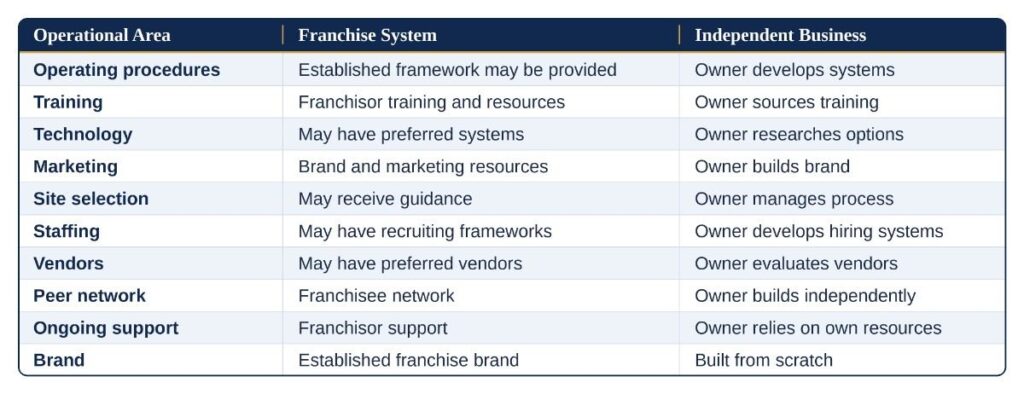
Neither model eliminates risk, and both demand strong management and execution. The real difference is where the owner starts.
How to Evaluate a Franchise’s Operational Support
Not every franchise offers the same level of help, so ask pointed questions before you invest:
- What training is provided before opening?
- What support continues after launch?
- Is ongoing operational coaching available?
- What technology is included?
- What marketing resources are provided?
- How does the franchise support staffing?
- What site-selection assistance is available?
- Are there preferred vendors?
- How accessible is the franchisor when you need them?
- What do current franchisees say about the support?
That last question may be the most revealing. Talking to current franchisees shows you whether the support described in the sales process actually shows up in practice.
How SOS Supports Franchise Owners
SOS Franchising gives entrepreneurs an established framework for understanding the cost to open an ABA center. Its infrastructure includes support for training, site selection, licensing guidance, marketing, business operations, financing resources, and ongoing franchise support.
For prospective owners, the value isn’t just a recognizable brand. It’s a set of systems and resources meant to guide the business from preparation through day-to-day operations.
Reduce Uncertainty With the Right Systems
Independent healthcare businesses ask owners to build many systems themselves. That can mean more flexibility, but it also means more choices, more research, and more experimentation.
Many franchise systems give you a complete operating framework covering operations, training, technology, marketing, staffing, site selection, and continuing support. That doesn’t erase financial, staffing, market, or execution risk. It can reduce the uncertainty of building a healthcare company from scratch.
When you evaluate a healthcare franchise, look past the brand. Read the aba franchise disclosure document, talk to current franchisees, find out how much support you’ll really get, and decide whether the model fits your goals.
For owners who want to build a mission-driven ABA business, SOS Franchising offers an organized model and business-side support for opening and running an ABA center.
Ready to explore the opportunity? Connect with SOS Franchising to learn more about the franchise model, the support system, and your next steps.
Frequently Asked Questions
1. Can a franchise help new healthcare owners avoid common startup mistakes?
Yes. A healthcare franchise may help new owners avoid common startup mistakes by providing established operating procedures, initial training, site selection guidance, and support with licensing requirements. These resources can help owners prepare for business operations, staffing, and marketing. However, franchise support cannot eliminate business risks or guarantee success.
2. What should I look for in a healthcare franchise’s support system?
Evaluate the franchise’s initial and ongoing training, operational guidance, technology systems, marketing resources, staffing support, site selection assistance, and vendor relationships. Ask whether the franchisor provides clear operating procedures, responds to franchisee questions promptly, and offers practical guidance when challenges arise.
3. How do franchisees benefit from lessons learned by other owners?
Franchisees can benefit from the experience of existing owners who have addressed similar operational challenges. Sharing practical insights about staffing, local marketing, vendor management, technology, and daily operations can help new owners make informed decisions. However, results may vary depending on the local market, management, and business circumstances.
4. Can franchise support adapt to different local markets?
Yes, some franchise systems allow flexibility to address local market conditions while maintaining consistent brand standards and operating procedures. This flexibility may apply to local marketing, community outreach, staffing strategies, and customer engagement. Before investing, ask the franchisor which decisions franchisees can make independently and which require approval.
5. What should I verify before relying on a franchise’s operational systems?
Review the Franchise Disclosure Document (FDD), where applicable, paying particular attention to the franchisor’s obligations, initial and ongoing fees, training, support provisions, and any disclosed financial performance representations. Speak with current and former franchisees to understand how well the operational systems work in practice. For healthcare franchises, also verify applicable licensing requirements, regulatory obligations, and the support available for meeting them.
The SOS Franchise Editorial Team shares insights and guidance for aspiring and current ABA clinic owners on franchising, operations, and growth with SOS Franchising.