Summary
Bringing together quality service delivery, accessibility, strong operations and finances, and appropriately skilled staff can allow companies working to support children with disabilities to make a lasting impact. SOS Franchising places a strong emphasis on entrepreneurship along with access to autism therapy, including franchise operator training, operational support, and resources.
A business can do more than generate revenue. By supporting children with disabilities, it can help families access essential services, create local employment opportunities, and contribute to stronger communities.
For entrepreneurs entering this space, balancing service quality, accessibility, and financial sustainability is essential. Various business models can support these goals, ranging from community-based programs to specialized service providers, each offering different ways to address the needs of children and their families.
SOS Franchising offers a structured approach to combining business ownership with a broader social purpose. Its franchise model equips entrepreneurs with training, operational support, and resources to open and operate SOS centers, with a focus on expanding access to autism therapy. Through this approach, entrepreneurs can work toward building financially sustainable businesses while helping more families access services and support within their communities.
What Does Long-Term Impact Mean for Children With Disabilities?
Long-term impact is about more than opening locations or increasing the number of families served. It is about whether a business contributes to meaningful, sustainable support for children and their families.
Impact on Children
Disability-focused services, including those offered through a daycare franchise, can support children in several areas, depending on their individual needs and goals:
- Functional skill development: Helping children build skills they can use in everyday tasks and routines.
- Communication: Supporting children in expressing their needs, thoughts, and preferences.
- Independence: Encouraging children to develop abilities that help them participate more independently in daily life.
- Participation in everyday activities: Helping children take part in routines, social interactions, and activities that matter to them.
- Individualized skills and goals: Focusing on progress based on each child’s abilities, needs, and developmental priorities.
Every child is different. The right goals and services should be based on the individual child’s needs rather than a one-size-fits-all approach.
Impact on Families
Families may benefit when services are available, consistent, and easier to access. A strong service provider can help families find appropriate support, understand their options, and work with professionals who understand their child’s needs. Consistent communication and guidance can also help families better understand the support their child receives.
Impact on Communities
Businesses serving children with disabilities can also contribute at the community level by:
- Expanding local access to services
- Creating employment opportunities
- Building relationships with local organizations
- Increasing awareness of disability-related needs
For SOS, improving access to autism therapy is central to its mission, making community reach an important part of the franchise model.
Business Models That Create Long-Term Impact for Children With Disabilities
There is no single business model that works for every community or disability service. Different models can create impact in different ways.
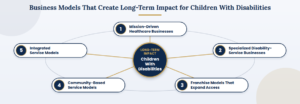
1. Mission-Driven Healthcare Businesses
A mission-driven healthcare business combines a clear social purpose with a sustainable operating model. These businesses typically focus on:
- Mission-led leadership: Keeping the organization’s purpose central to its decisions and priorities.
- Quality services: Providing services that are appropriate to the needs of the people being served.
- Strong community relationships: Building connections that help the organization understand local needs.
- Sustainable finances: Managing revenue and costs so services can continue over time.
- Investment in employees and infrastructure: Supporting staff, facilities, technology, and systems needed for reliable operations.
Financial sustainability matters because a business cannot serve families effectively if it cannot maintain its staff, facilities, technology, and day-to-day operations. The goal is to create a business that can continue supporting its mission year after year.
2. Specialized Disability-Service Businesses
Another model focuses specifically on services for children with disabilities. Depending on the organization’s focus, services may include:
- Behavioral support: Helping children work toward individualized goals through appropriate strategies and support.
- Occupational therapy: Supporting skills used in everyday activities, depending on the child’s needs.
- Speech and communication services: Helping children develop ways to communicate and interact.
- Family training: Giving families information and strategies that can support consistency across everyday settings.
Specialization allows organizations to develop expertise around the population they serve. It can also help teams create processes, training, and resources that are relevant to clients’ specific needs. For families, specialized providers can offer a more focused approach to care and support.
3. Franchise Models That Expand Access
Franchising is another business model that can support expansion. A franchise can combine:
- Established business systems: Giving owners a framework for setting up and managing daily operations.
- Brand recognition: Helping a business enter the market with an established identity.
- Training: Preparing owners and teams to understand the model and their responsibilities.
- Operational support: Providing guidance on running the business and managing its processes.
- Standardized processes: Creating consistency across locations while allowing for local needs.
- Local ownership: Giving owners a direct role in operating the business and serving their communities.
Instead of asking every new owner to build an entire business infrastructure independently, the franchise model provides an established framework.
This can make it easier for entrepreneurs to enter a specialized field and bring services to additional communities.
But expansion alone does not equal impact. Growth needs to be accompanied by qualified staffing, appropriate services, strong operations, quality standards, and attention to the needs of the families being served.
How SOS Uses the Franchise Model
SOS Franchising is a franchise company that enables entrepreneurs to open and operate Success On The Spectrum centers.
Local franchise owners run their operation while having access to the entire SOS system. It combines local ownership with a proven model to start and operate an autism therapy clinic.
That can even create pathways for an entrepreneur to take on business ownership while fulfilling a larger sense of mission than just that of his or her business.
The key difference is that the franchise model provides you with infrastructure. But the ultimate result depends on how that infrastructure is utilized, and the caliber of services provided in each center, as well as their accessibility to local communities.
4. Community-Based Service Models
Accessibility is an important part of long-term impact.
Community-based businesses are designed to make services available closer to where families live, work, and go to school.
When appropriate services are available locally, families may have more practical options for accessing support.
For disability-service businesses, understanding the needs of the local population is therefore an important part of choosing where and how to operate.
5. Integrated Service Models
Children with disabilities may interact with multiple professionals and systems. Depending on the child’s needs, this can involve families, therapists, schools, healthcare professionals, and community organizations.
Integrated models aim to improve coordination between these groups. Potential benefits include:
- Better communication
- More coordinated goals
- Less duplication
- Easier navigation for families
- More consistent support
Integration does not mean every child needs every service. It means that when multiple services are appropriate, better communication between the people involved can make the overall experience easier to navigate.
How Should Businesses Measure Long-Term Impact?
Revenue is important for sustainability, but it should not be the only measure of success for a disability-focused business. Businesses should also consider what their operations mean for children, families, employees, and communities.
Access
To understand how well a business reaches the families who need support, consider the following measures:
- Families served: Tracking how many families use the services.
- Geographic availability: Reviewing which communities can reasonably reach a location.
- Availability of appropriate services: Checking whether the services offered match local needs.
- Ability to reach underserved communities: Considering whether families with fewer local options can access support.
Quality
Service quality depends on qualified staff, consistent delivery, and processes that help maintain appropriate standards. Businesses can assess this through:
- Staff qualifications: Confirming that team members have the qualifications required for their roles.
- Consistency of service delivery: Reviewing whether services follow appropriate processes across visits and locations.
- Family experience: Gathering feedback about communication, access, and service interactions.
- Quality processes: Using suitable procedures to review and improve service delivery.
Individual Progress
Measuring individual progress helps businesses understand whether services are supporting children in working toward their personal goals. Depending on each child’s needs, this may include:
- Functional skills: Changes in skills used in everyday tasks.
- Communication: Progress in expressing needs, preferences, or ideas.
- Independence: Development of abilities that support participation in daily life.
- Participation in everyday activities: Changes in a child’s ability to take part in meaningful routines and activities.
Workforce
A capable, supported workforce plays an important role in maintaining service quality. Businesses can monitor staff development and workplace stability through:
- Staff retention: Understanding whether employees stay with the organization over time.
- Training: Tracking whether staff receive relevant preparation and ongoing learning.
- Professional development: Supporting opportunities to build role-related skills.
- Employee engagement: Understanding how staff experience their work and workplace.
Community
A business’s long-term impact also depends on how it engages with the wider community and responds to local needs. Relevant measures include:
- Local partnerships: Building relationships with relevant organizations in the area.
- Community involvement: Taking part in appropriate local activities and initiatives.
- Educational initiatives: Sharing useful information about disability-related services and needs.
- Awareness and outreach: Helping families and community members learn about available support.
For a mission-driven franchise, business growth is only one part of the picture. The larger question is whether the organization can expand access while continuing to provide appropriate, quality services.
Can Profit and Purpose Work Together?
It takes entrepreneurial expertise, as some executive directors may be reluctant to combine profit with the social sector-driven mission. Financial viability and purpose do not have to be mutually exclusive.
A disability accountable business requires income to supply wages, run a facility, spend money on technology, practice abilities, and keep the doors open.
Even with a strong mission, it can be hard to sustain without a solid financial model. It is not about a dichotomy of purpose vs. profitability. It is about creating a sustainable model of business that allows the mission to be self-supportive through its financial success.
That is especially critical in health and disability services, where continuity of staffing and infrastructure are crucial in being able to provide support for families.
SOS Franchising represents this process by combining entrepreneurship with a mission centered on expanding access to autism therapy. The franchise model gives entrepreneurs a way to enter the autism services space while operating within an established business framework.
Why SOS Franchising Is Built Around Long-Term Impact
For entrepreneurs considering a mission-driven healthcare business, SOS offers a model built around both business ownership and access to autism services. SOS Franchising provides extensive start-up assistance and support across important areas of the business, including:
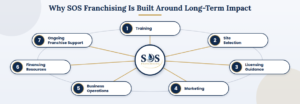
- Training
- Site selection
- Licensing guidance
- Marketing
- Business operations
- Financing resources
- Ongoing franchise support
This support is intended to help entrepreneurs with related operations of opening such centers. This model is also indicative of SOS’s larger goal to increase access to autism therapy through centers owned by local families.
That blend can help tell an attractive story to entrepreneurs looking for something more than “just” a business opportunity. They could want to do all of these: build a company, at the same time lead a team, serve families, and stay relevant in the world.
A franchisee, however, does not make a social impact by virtue of becoming a franchise owner automatically. The owner still needs to effectively manage the leadership, hire a well-qualified team, follow proper protocols and standards, and stay focused on each family the center is serving. That is why the right question is not simply, “Can this business grow?”
It is also: Can this business grow sustainably while continuing to serve its mission well?
For a purpose-driven entrepreneur, that distinction matters.
Build a Business That Can Keep Making a Difference
A meaningfully impact mission isn’t enough for the long haul. It needs sustainable finances, competent people, reliable systems, good services, and continual investment.
This can support a variety of business models, including dedicated disability-service businesses and community-based organizations as well as big franchise systems.
Franchising, however, provides entrepreneurs a structured way to enter into a particular industry by having access to known systems, training, and support. These resources, in combination with local leadership and a focus on quality, form the basis for long-term growth.
One of those examples is SOS Franchising, which focuses on gaining greater access to autism therapy through its franchise model.
If you are an entrepreneur who is thinking of this route, your aim shouldn’t stop at finding a company nowadays. Your goal should be to look for a model that will last in its function and purpose in the years to come.
If you want to learn more about a healthcare entrepreneurship opportunity where you can make a difference, check out the SOS Franchising opportunity and how its franchise model and its training and support can take your next step.
FAQs
- What makes a business model impactful for children with disabilities?
A successful business model relates to proper services, capability, affordability, competent staff with good operations, and financial sustainability. Ideally, it does so in a way that creates real value for children and families whilst linking it with a viable long-term operating business.
- Can a disability-focused business be both profitable and mission-driven?
Yes. Financial sustainability can support the mission by funding employees, facilities, training, technology, and continued service delivery. Purpose and profitability can work together when the business is built responsibly.
- How can franchising help expand access to disability services?
This is where a franchise can give entrepreneurs systems, training, operational support, and branding support. This could allow franchisees to operate in more communities without having to re-invent every system.
- Do I need a healthcare background to operate a disability-service franchise?
Requirements vary by franchise. SOS Franchising claims that its franchise opportunity will suit anyone, regardless of their background, and prior autism or healthcare experience is not required. Before investing in a franchise, potential owners should be aware of the unique qualifications and responsibilities expected of them, along with the assistance offered to help them succeed.
- What support does SOS provide franchise owners?
SOS provides support in areas including training, site selection, licensing guidance, marketing, business operations, financing resources, and ongoing franchise support. Prospective franchisees should review the current franchise materials to understand the specific support included.
The SOS Franchise Editorial Team shares insights and guidance for aspiring and current ABA clinic owners on franchising, operations, and growth with SOS Franchising.