


Summary
Healthcare franchise ownership can be a purposeful and powerful way for professionals to transition into entrepreneurship. Rank yourself on the following before investing: your experience level, financial reserve, time bandwidth, ability to learn, and belief in the mission. SOS fills this gap as an ABA franchise, offering training, support, and a proven system for building a purpose-driven business.
What if your next career move wasn’t another job?
The concept of going into business for entrepreneurs is a thrilling proposition for many professionals. However, if your desire goes beyond monetary independence, you might wish for work that is infused with purpose.
This is where owning a healthcare franchise can be an exciting choice of career.
A healthcare franchise is a mix of owning a business and providing the community with services that are in high demand. It can mean, for an individual looking at a new ABA franchise opportunity, building a business to help children and families impacted by autism.
However, purchasing a health maintenance franchise is not just about changing your job. Being a business owner is a choice decision.
This can be the reason long or short, but it really comes down to asking yourself some hard questions, looking into your leadership capabilities, financial preparedness, time commitment, willingness to learn, and what makes you want to make this change.
Refer to this checklist to help decide if healthcare franchise ownership may be your next step.
Are You Ready to Become a Business Owner?
The first question isn’t even healthcare-related.
It’s about ownership.
You are hired in a certain organization to do a specific job. You’re the owner, and you are responsible for that bigger picture.
You might have to decide on employees, money management, finances, marketing, growth, and the general course of your company.
Ask yourself:
- Do I want to make business decisions rather than follow an employer’s direction?
- Am I comfortable being accountable for results?
- Am I prepared to manage people and finances?
- Do I want an active ownership role?
Your Checklist
- I want to build and operate a business.
- I am comfortable making decisions.
- I am prepared to take responsibility for business performance.
- I understand that franchise ownership requires active involvement.
If the idea of building something of your own excites you, you’re already asking the right questions.
Do Your Skills Transfer to Healthcare Franchise Ownership?
You don’t need a specific degree to be a good franchise owner.
In fact, some of the most valuable skills you bring may have nothing to do with healthcare.
Think about your experience leading projects, managing people, solving problems, communicating with customers, or making decisions under pressure.
Look for Strengths in:
- Leadership
- Communication
- Organization
- Problem-solving
- Coaching
- Team building
- Financial awareness
- Adaptability
These skills can be valuable in almost any business, including an ABA center.
You also don’t necessarily need an ABA background. SOS Franchising provides training and support designed to help franchise owners learn the business and understand the systems involved in operating an ABA therapy center.
Your role is not to become a clinician.
Your role is to lead the business, build the team, manage operations, and create an environment where your professionals can do their best work.
Are You Comfortable Leading a Team?
Healthcare businesses are people businesses.
An ABA center depends on qualified clinical and administrative professionals working together. As an owner, you’ll need to build that team and help create a workplace where people want to stay and grow.
Ask yourself:
- Do I enjoy developing employees?
- Can I give constructive feedback?
- Can I have difficult conversations when necessary?
- Do I know how to motivate a team?
- Can I create a positive workplace culture?
You don’t need to be the loudest person in the room to be a good leader.
You need to communicate clearly, listen, set expectations, and follow through.
Are You Financially Prepared?
A career transition should never be based on excitement alone.
Before investing in a healthcare franchise, understand exactly what the opportunity requires financially.
Look at:
- Available liquid capital
- Total franchise investment
- Financing requirements
- Existing debt
- Personal financial obligations
- Working capital
- Emergency reserves
- Ongoing business expenses
Don’t Look Only at the Franchise Fee
The franchise fee is just one component of the investment.
You must also know the expenses of your real estate, build-out, equipment, employees, insurance, technology, marketing, working capital, and other overhead costs.
SOS education offers prospective owners information and resources pertaining to the steps you need to go through for making a solid investment and a clear business plan. But you need to refer to the current FDD, and you should have experienced financial and legal experts assess the numbers.
Know what you’re investing before you decide what you’re building.
Are You Comfortable With the Owner’s Time Commitment?
A franchise is not necessarily a turnkey investment.
Others are interested in franchising because they desire an already established framework. That’s a valid reason. An established system does not mean that you can walk away from the business.
SOS advocates an active ownership model, and so potential owners must understand what active ownership entails.
Ask yourself:
- How involved do I want to be?
- Am I prepared to manage employees?
- Can I spend meaningful time at the center?
- Am I comfortable overseeing day-to-day operations?
- Does this business fit the lifestyle I want?
Be honest here.
The goal isn’t to convince yourself that you can make the business fit your life. It’s to determine whether the ownership role actually fits the life you want to build.
Are You Comfortable Entering a Healthcare-Related Industry?
You don’t have to be a clinician to own an ABA franchise.
But you do need to be comfortable operating within a healthcare environment.
That can include understanding the importance of:
- Professional standards
- Licensing requirements
- Insurance processes
- Documentation
- Privacy
- Clinical teams
- Quality expectations
- Family communication
Healthcare also comes with responsibilities that you may not encounter in a traditional retail or consumer business.
The good news is that you don’t have to arrive knowing everything.
A franchise system can provide training, systems, and operational support to help you understand the business.
Does the Mission Matter to You?
This may be one of the most important questions for an SOS franchise owner.
Why do you want to do this?
If the only answer is “because it looks profitable,” take some time to think about whether healthcare ownership is actually right for you.
SOS is built around a mission of expanding access to autism services while allowing entrepreneurs to build their own businesses.
You don’t need to have personal experience with autism to care about that mission.
But you should genuinely care about the people your business serves.
Ask yourself:
- Do I want my business to have a meaningful purpose?
- Am I motivated by helping children and families?
- Do I care about improving access to autism services?
- Can I balance mission with sound business decisions?
A purpose-driven business is still a business. Financial discipline and responsible management matter just as much as passion.
Are You Willing to Learn What You Don’t Know?
Changing careers means accepting a learning curve.
Even if you’re an experienced manager or successful entrepreneur, there will be things about the ABA industry and franchise model that are new to you.
You may need to learn about:
- ABA operations
- Staffing
- Healthcare business processes
- Financial management
- Marketing
- Local business development
- Franchise systems
This is where the right franchise support can make a difference.
SOS provides training and ongoing support to help franchise owners learn its model and navigate the process of opening and operating an ABA center.
You don’t have to know everything before you start.
You do need to be willing to learn.
Are You Comfortable Following a Proven Franchise System?
Franchising gives you a framework.
That’s one of its biggest advantages.
Instead of starting a business completely from scratch, you have access to an established brand, operating processes, training, and support.
But there is a trade-off.
You don’t have unlimited freedom to change every part of the business.
Ask yourself:
- Can I follow established systems?
- Am I comfortable operating within brand standards?
- Can I accept guidance from the franchisor?
- Can I lead my local team while following the franchise model?
The best franchise owners understand that entrepreneurship and structure can work together.
You get to build your business while working within a proven framework.
Have You Done Your Due Diligence?
Before making a career transition, slow down and do your homework.
Review the franchise’s:
- Franchise Disclosure Document
- Initial investment
- Ongoing fees
- Territory structure
- Training
- Support
- Franchisee obligations
- Financial performance information, if provided
Then talk to current franchisees.
Ask Them About:
- Their startup experience
- Financing
- Staffing
- Owner workload
- Franchisor support
- Challenges
- Growth
- What they wish they knew before starting
A franchise website can explain the opportunity.
A franchisee can tell you what ownership actually feels like.
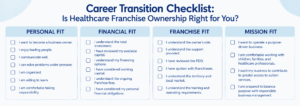
Career Transition Checklist
Before moving forward, use this quick checklist.