

Summary
Choosing between a healthcare and restaurant franchise starts with understanding your goals, resources, and preferred business model. An ABA franchise like SOS offers a need-based, purpose-driven opportunity with ongoing client relationships, professional support, and a focus on serving children and families.
It is easy to gravitate towards businesses you are already familiar with when selecting a franchise to invest in. Restaurants are known quantities; you know what the customer experience is, what it costs to operate, and you can see if there is actual demand.
However, familiarity does not make a business the right investment every time.
When choosing a franchise, ask, What do I want to build as an actual business?
Restaurant franchises rely on customer desires. However, healthcare franchises provide services that are based upon a customer’s need forever. Neither promises success, but knowing the difference between the two can help you choose the right approach.
For entrepreneurs seeking a purpose-driven business, an ABA franchise such as Success On The Spectrum (SOS) is one healthcare model worth considering.
Healthcare Franchise vs. Restaurant Franchise: What’s the Difference?
At first glance, a restaurant franchise and an ABA franchise may seem like completely different businesses. They are.
That difference starts with how each business generates demand.
How a Restaurant Franchise Works
A restaurant generally depends on:
- Customer transactions
- Foot traffic
- Location
- Menu and pricing
- Food and inventory
- Labor
- Customer experience
- Consumer spending
Someone decides to eat at the restaurant, makes a purchase, and leaves. The business needs a consistent flow of customers and transactions to keep revenue moving.
That can create significant opportunities, but it also means restaurants must continually attract customers and manage the costs associated with serving them.
How a Healthcare Franchise Works
Healthcare franchising is built around professional services rather than products.
An ABA therapy center, for example, may involve:
- Ongoing client relationships
- Professional service delivery
- Specialized employees
- Insurance and reimbursement
- Clinical requirements
- Regulatory responsibilities
- Community relationships
Families aren’t usually looking for ABA therapy because they simply feel like making a purchase. They seek services because their child has a need and they are looking for appropriate support.
The Biggest Difference: What Drives Demand?
Restaurant: Consumer choice and discretionary spending.
Healthcare: A continuing need for care or support.
That doesn’t make healthcare automatically easier. It simply creates a different business environment.
What Does the Data Say About Business Longevity?
Before comparing industries, it is important to look at reliable data rather than broad claims about which businesses “always” succeed.
According to the U.S. Bureau of Labor Statistics, 34.7% of private-sector establishments born in March 2013 were still operating 10 years later in March 2023. For that same group, the 10-year survival rate was 38.2% for accommodation and food services and 35.7% for health care and social assistance.
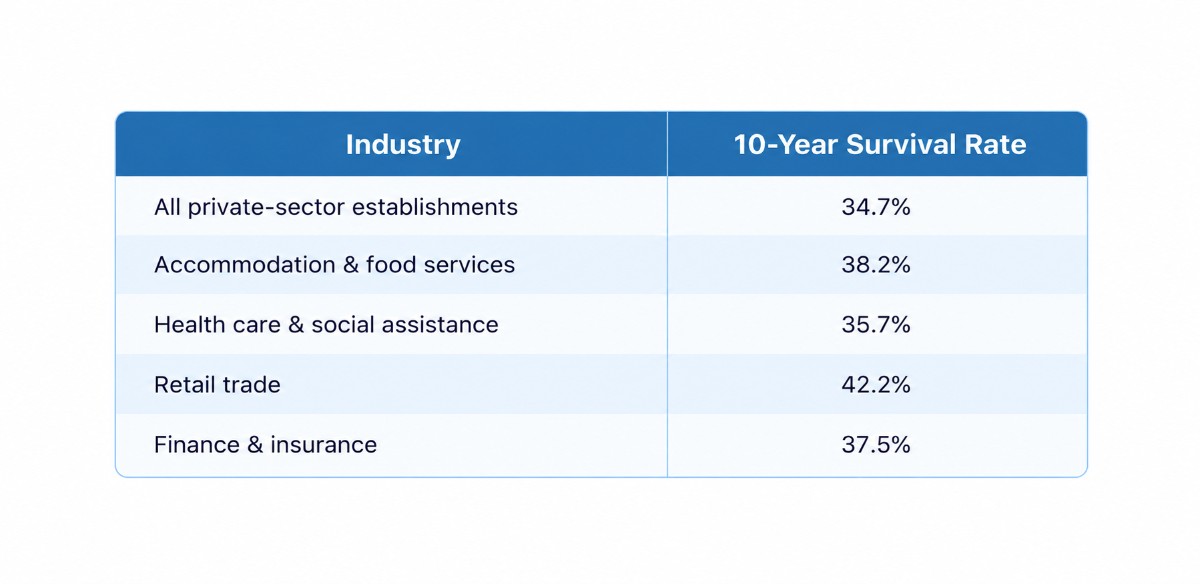
These numbers are important because they provide context.
They also show why you should not use industry survival data to claim that healthcare businesses are automatically more resilient than restaurants. The BLS data covers establishments, not franchises, and it does not tell us how an individual franchise system will perform.
Instead, prospective franchise owners should look at the bigger picture.
What Should Franchise Buyers Actually Measure?
Before investing, investigate:
- Franchisee closures
- Franchisee retention
- Years in operation
- Unit growth
- Initial investment
- Ongoing fees
- Financial performance representations
- Franchisor support
- Local demand
- Staffing requirements
The question isn’t simply, “Which industry has the highest survival rate?”
It is: “Does this particular franchise have a business model and support system that makes sense for me?”
Why Restaurant Franchises Can Be Challenging
Restaurants can be excellent businesses for the right entrepreneur. But they come with a unique set of operating challenges.
High Labor Dependence
Restaurants need people to operate.
Owners have to manage:
- Recruiting
- Scheduling
- Training
- Turnover
- Performance
- Customer service
Labor challenges can quickly affect the customer experience and operating costs.
Inventory and Food Costs
Unlike a professional service business, restaurants have physical inventory that can spoil, become damaged, or go unused.
Owners need to manage:
- Food costs
- Waste
- Suppliers
- Inventory levels
- Portion control
Small changes in costs can have a meaningful impact on margins.
Location Matters
A restaurant often depends heavily on visibility and traffic.
Rent, parking, accessibility, nearby competitors, demographics, and foot traffic can all influence performance.
Customer Spending Is Transactional
Customers choose when and where they want to eat.
Which means restaurants need to be getting customers back through the doors as well.
Customer traffic can vary from month to month due to economic conditions, changing consumer preferences, competition, and local events.
The Owner’s Daily Role
Owning and running a restaurant means being pedantic about everything, from staffing to inventory to equipment to customer service and quality control.
To an entrepreneur with a passion for hospitality, that might be all they want.
If a business experience, for which they are looking for something different, is preferred, another franchise model might be more suitable.
Why Healthcare Franchising Is Worth Considering
Healthcare has its own challenges, but the underlying customer relationship can be very different.
Healthcare Addresses Ongoing Needs
Healthcare isn’t typically an impulse purchase.
Families seek services because there is a need that requires attention.
In some healthcare businesses, that can create longer-term relationships between providers, patients, and families.
Service Relationships Can Be Ongoing
A restaurant may have thousands of individual transactions.
A healthcare business may develop continuing relationships with the people it serves.
For an ABA center, that can mean working with children and families over an extended period while providing individualized services.
That creates a different kind of business relationship, one built around consistency, trust, and service.
A More Purpose-Driven Business
This is one of the biggest reasons entrepreneurs explore healthcare franchising.
You aren’t simply opening another location in a consumer category.
You’re building a business that can:
- Serve families
- Create jobs
- Develop professional teams
- Build community relationships
- Expand access to important services
That combination of purpose and entrepreneurship is central to the SOS Franchising model.
Healthcare Is Still a Business
Purpose doesn’t eliminate business responsibilities.
Healthcare franchise owners still have to manage:
- Staffing
- Finances
- Compliance
- Licensing requirements
- Insurance and reimbursement
- Quality control
- Operations
- Growth
Healthcare is not automatically low-risk.
It simply offers a different kind of opportunity.
Why ABA Therapy Is a Unique Healthcare Franchise Opportunity
Now let’s narrow the conversation to ABA therapy.
What Is ABA Therapy?
Applied Behavior Analysis (ABA) is an evidence-based approach commonly used to support children with autism by teaching skills and addressing behaviors that can interfere with learning and daily life.
Depending on the individual child and treatment plan, services may focus on areas such as:
- Communication
- Social skills
- Daily living skills
- Learning
- Behavior support
- Independence
For families seeking these services, finding accessible, high-quality care can be a major priority.
Why Families Seek ABA Services
An ABA therapy cost demonstrates a need for continued help, not unlike the need for food at a restaurant but even longer lasting.
And families might seek providers who they believe will provide certain services, qualified professionals, a supportive environment, and a model of treatment they’re comfortable with.
Which can lead to a totally different relationship with the business and its customers.
The ABA Market Is Changing
The ABA industry is also becoming increasingly competitive.
SOS states that market research suggests nine large multisite ABA companies operate an estimated 38% of ABA centers in the U.S.
That makes the franchise model itself an important consideration.
The question isn’t only:
“Is there demand for ABA?”
It is also:
“What kind of ABA organization do I want to build?”
SOS positions its model around locally owned and operated centers with hands-on owners, emphasizing personalized care, parent transparency, and community involvement.
Healthcare Franchise vs. Restaurant Franchise: Side-by-Side Comparison
| Factor | Restaurant Franchise | ABA / Healthcare Franchise |
| Primary demand | Consumer spending | Healthcare need |
| Revenue | Individual transactions | Professional services |
| Customer relationship | Often shorter-term | Can be ongoing |
| Inventory | Food and products | Primarily professional services |
| Labor | Restaurant employees | Clinical and administrative team |
| Location | Traffic and visibility | Accessibility and territory |
| Regulation | Food and business requirements | Healthcare and clinical requirements |
| Owner role | Operations and customer experience | Leadership and operations |
| Community impact | Local consumer service | Healthcare and family support |
| Recurring demand | Depends on customer behavior | Can involve continuing services |
| Industry knowledge | Food-service operations | Healthcare business operations |
| Franchise support | Depends on franchisor | Depends on franchisor |
Neither model is automatically better.
The better choice depends on your goals, financial resources, management style, market, and the type of business you want to operate.
Why Choose Success On The Spectrum?
You now know that healthcare franchising is worth considering, and the next question is what franchise system makes sense?
When SOS opened the first Success On The Spectrum center in Houston back in 2015, it was a response to her time as an autistic parent. In 2018, SOS began franchising and is billed as the first ABA franchise in the country. The SOS website currently states that the brand has over 100 territories awarded and a decade of experience.
The franchise’s model is predicated on expanding access to autism services and allowing entrepreneurs the ability to own a business.
Hands-On Ownership
SOS emphasizes locally owned centers and hands-on franchise ownership.
The idea is simple:
The owner shouldn’t disappear behind the business.
Active owners can build relationships with employees, families, and their communities while staying involved in the day-to-day operation of the center. SOS connects this hands-on approach with its focus on care quality, staff engagement, and operational performance.
Comprehensive Franchise Support
For someone entering healthcare without an existing ABA business, support matters.
SOS describes support across areas such as:
Before opening
- Territory selection
- Real estate
- Business planning
- Financing guidance
During the opening process
- Training
- Clinic setup
- Hiring
- Marketing
- Licensing guidance
After opening
- Ongoing training
- Quality assurance
- Operations support
- Marketing support
The specific terms and support available should always be confirmed in the current SOS Franchise Disclosure Document and franchise materials.
Is an ABA Franchise More Resilient Than a Restaurant Franchise?
This is where it is important to separate potential advantages from guarantees.
An ABA franchise may be attractive to entrepreneurs because it combines a need-based service with ongoing client relationships and a mission-driven business model.
A restaurant, meanwhile, operates around consumer transactions and discretionary spending.
But neither model is immune to challenges.
Instead of asking which industry “cannot fail,” look at:
Demand
Is the business providing something people actively need?
Revenue Model
Does revenue come from individual transactions or ongoing services?
Operating Model
What are the staffing, inventory, technology, and facility requirements?
Franchise System
What training, support, systems, and resources does the franchisor provide?
Local Market
Is there sufficient demand and an appropriate workforce in the territory?
Financial Requirements
Can you realistically support the investment and working capital requirements?
These questions provide a much more useful basis for comparison than an industry-wide survival statistic.
Who Should Consider an ABA Franchise?
An ABA franchise may be worth exploring if you are:
- An entrepreneur looking for purpose-driven ownership
- A corporate professional ready for a career change
- An existing business owner
- A community-minded leader
- Comfortable managing teams
- Interested in building a long-term business
- Motivated by helping children and families
An ABA Franchise May Not Be Right For You If…
You are looking for:
- A completely passive investment
- Minimal employee management
- No healthcare-related responsibilities
- Guaranteed returns
- A business requiring little owner involvement
SOS’s hands-on ownership model makes it particularly important to understand what active franchise ownership involves before making a commitment.
Healthcare Franchise vs. Restaurant Franchise: Which Should You Choose?
There is no universal answer.
Choose a Restaurant Franchise If…
A restaurant may be a good fit if you:
- Enjoy hospitality
- Understand food-service operations
- Like a consumer-facing environment
- Are comfortable managing inventory
- Enjoy high-volume transactions
- Want to build a business around customer experience
Consider Healthcare Franchising If…
Healthcare may be worth exploring if you:
- Want a need-based service business
- Value ongoing client relationships
- Want meaningful community impact
- Are comfortable leading professional teams
- Want to build a purpose-driven business
Consider SOS If…
SOS may be worth exploring if you:
- Want to enter the healthcare space without being a clinician
- Are interested in autism services
- Want an established ABA franchise model
- Prefer hands-on ownership
- Want your business to have a meaningful community purpose
Youtube Video Link: https://youtube.com/shorts/s2Yd4AKw7S0
The Bottom Line: Your First Franchise Should Do More Than Open
A restaurant franchise and a healthcare franchise are fundamentally different businesses.
One is built around consumer transactions. The other is built around professional services and ongoing needs.
Neither guarantees success.
But if you’re evaluating franchises for the long term, don’t stop at the franchise fee or the popularity of the brand.
Look at demand, revenue structure, operating complexity, staffing, local market conditions, franchisor support, financial requirements, and the type of owner you want to become.
For entrepreneurs who want a business with both commercial potential and a meaningful mission, an ABA franchise can be an alternative worth exploring.
That is the opportunity SOS Franchising is built around: helping entrepreneurs open and operate ABA therapy centers while expanding access to services for children and families.
Ready to Build a Business With Purpose?
You don’t need to be a healthcare professional to explore ABA franchise ownership.
You need the willingness to learn, the ability to lead a team, and the commitment to build a business that serves families in your community.