Summary
ABA franchises differ in business models, startup costs, royalties, owner responsibilities, clinical support, training, staffing, technology, territories, revenue models, and marketing. Success On The Spectrum (SOS) offers a center-based, hands-on ownership model with support in operations, training, recruiting, site selection, marketing, and clinical services. Prospective owners should compare systems carefully, review FDDs, and consult franchisees.
Selecting an ABA franchise is more than just finding a brand name. However, two franchises may provide Applied Behavior Analysis (ABA) services, but the businesses behind them can vary immensely.
Varying points are as abundant as strategy, startup costs, royalty structure, owner responsibilities, clinical support technology, and territory price marketing, schooling, etc. You can even distinguish the way services are delivered.
This is why future franchise owners must look beyond the franchise fee and evaluate the overall franchise system.
If you’re an entrepreneur looking at a potential ABA franchise, Success On The Spectrum (SOS) gives one example of a center-based model to consider. SOS Franchising supports entrepreneurs opening and operating an autism treatment center in a physician-based model, offering assistance on training, site selection, recruiting, marketing strategies, credentialing (including insurance contracts), and overall operations.
The goal is not to determine which franchise is automatically “best.” It is to understand what makes each opportunity different and determine which model fits your goals, resources, and expectations.
10 Factors That Make ABA Franchises Different
Before choosing an ABA franchise, look at the business from every angle. The following factors can help you compare opportunities more meaningfully.
-
Consider How Established the Franchise System Is
A franchise is more than a brand name. You are purchasing access to a business system that should ideally have been tested across multiple owners, markets and operating environments.
One useful metric is the number of locations actually operating.
As of July 2026, the comparison provided shows:
Success On The Spectrum: 97 locations
Hi-5: 30 locations
Autism Care Therapy (ACT): 22 locations
Essential Speech & ABA: 16 locations
Able Autism: 7 locations
Beyond The Label: 2 locations
The systems also differ considerably in how long they have been franchising.
Location count alone does not determine franchise quality. A newer franchise may offer an excellent opportunity.
However, a larger operating network can give prospective owners more information to evaluate.
Ask how many locations have opened, how many have closed, how long locations typically take to open, and how existing franchisees are performing.
Most importantly, talk to franchisees.
The Franchise Disclosure Document provides important information, but conversations with actual owners can help you understand what operating the business is really like.
The franchise fee is often one of the first numbers prospective owners compare—but it represents only a small portion of the financial relationship between a franchisee and franchisor.
Prospective owners should calculate the total cost of the franchise system, including:
- Initial franchise fee is generally paid once. SOS charges $45,000 for this fee.
- Royalty fees: Success On The Spectrum (SOS), for example, charges 5% of gross revenue but caps the royalty at $5,000 per month. Other ABA franchise systems charge 5%, 7%, or 8% without a stated monthly cap in the information provided. That distinction becomes increasingly important as a location grows. At higher revenue levels, the difference between royalty structures could amount to tens of thousands of dollars per year.
- Marketing or brand fund fees: SOS does not charge a marketing fee, but franchisees do get a custom grand opening video, plus access to a growing collection of pre-made picture ads and video ads.
- Billing fees: Some ABA franchises control claim submission for the franchisee and collect another 4-8% of your revenue. SOS has no billing fee.
- Credentialing and contracting fees: You must apply to be in-network with insurance companies in order to serve most clients. Some companies charge $500-$1000 per application. SOS assist you with these applications for no charge.
-
The ABA Franchise Business Model
Start with the most fundamental question:
How does the franchise actually operate?
ABA services may be delivered through center-based, home-based, school-based, or hybrid models. Some businesses operate smaller clinics, while others are designed around larger centers serving more children.
A center-based model typically requires a larger real-estate investment, construction or build-out, furniture and facility management. In exchange, owners may have greater control over the treatment environment and the ability to centralize employees and services.
An in-home model may have lower initial real-estate requirements but creates different challenges involving employee travel, scheduling, supervision and geographic coverage.
Age restrictions can significantly affect the size of the potential client population. Most ABA business do not serve children older than age 6.
Questions to Ask
- Where are services delivered?
- What age population can I serve?
- What are the primary revenue sources?
SOS offers center-based, in home, and school shadowing ABA services. SOS also offers Speech therapy, occupational therapy, and social skills classes. SOS serves children up to age 18- one of the largest ranges of ages in the market.
That distinction matters. Someone comparing franchise opportunities should understand what running a center-based operation looks like before deciding whether the model fits their goals.
4. Owner Role and Time Commitment
This is one of the most overlooked differences between franchise opportunities.
Do you want to operate the business yourself, or are you primarily looking for an investment?
Those are very different objectives.
Ask whether the franchise is designed for:
- Daily owner involvement
- Hands-on management
- A hired general manager
- A semi-absentee owner
- Multi-unit ownership
Questions to Compare
- How many hours is the owner expected to work?
- Who manages employees?
- Who handles business development?
- Who oversees the center?
- What responsibilities remain with the owner?
- Which decisions require franchisor approval?
SOS emphasizes a hands-on ownership model. Franchise owners are expected to take an active role in operating their center rather than treating the business as a completely passive investment.
That may be appealing to an entrepreneur who wants to build a business and be closely involved in its development. It may be less suitable for someone specifically looking for a passive investment.
The right question is not simply, “Which model is better?”
It is:
“Which ownership model fits me?”
4. Clinical Support and ABA Expertise
An ABA franchise is different from many other franchise opportunities because the business depends on clinical services.
A prospective owner should understand how the franchisor supports the clinical side of the operation.
Compare:
- BCBA support
- Clinical leadership
- Treatment standards
- Clinical training
- Quality assurance
- Data collection
- Parent communication
- Documentation
- Ongoing clinical consultation
The owner does not necessarily need to be an ABA clinician. However, the franchise system should make clear who handles clinical responsibilities and what infrastructure is available to support quality care.
Key Question
What clinical infrastructure does the franchisor provide to help an owner operate an ABA center?
SOS is built specifically around autism treatment and ABA services. Its franchise support structure is designed to help franchise owners navigate both the business and operational requirements associated with establishing a center.
When comparing SOS with another ABA franchise, prospective owners should look closely at exactly what clinical and operational support is included.
5. Training and Onboarding
You do not need to know everything on day one.
But you do need to know what the franchisor will teach you.
Training can have a major impact on an owner’s learning curve, especially when entering the ABA industry without previous healthcare or autism experience.
Compare:
- Initial franchise training
- In-person training
- Operations manuals
- Business training
- Clinical education
- Technology training
- Hiring training
- Marketing training
- Ongoing education
- Post-opening support
Questions to Ask
- How long does initial training last?
- Where does training take place?
- Who conducts the training?
- What happens after the center opens?
- Is ongoing training available?
- Who can the owner contact when an operational problem comes up?
SOS positions training and ongoing operational support as important parts of its franchise system.
When comparing franchises, don’t just ask whether training exists. Ask how much training you receive, what it covers, and what support remains available after opening.
6. Staffing and Recruiting Support
Staffing can become one of the biggest operational considerations for an ABA center.
A successful center needs qualified clinical and administrative team members, which can include BCBAs, RBTs or technicians, administrative employees, and clinic leadership.
Compare Support for:
- Recruiting
- Hiring
- Onboarding
- Training
- Employee development
- Retention
- Clinic leadership
Ask whether the franchisor provides recruiting resources, standardized hiring processes, training materials, or other systems to help franchisees build their teams.
A strong marketing program may help generate inquiries from families, but the center still needs the people to provide services.
The ability to build and maintain a qualified team can be just as important as generating leads.
7. Territory and Market Support
A strong franchise brand does not automatically make every market equally attractive.
The local market matters.
When comparing territories, consider:
- Population
- Autism-service demand
- Competition
- Demographics
- Insurance environment
- School systems
- Healthcare providers
- Referral opportunities
- Local labor availability
Site Selection Support
Find out whether the franchisor helps with:
- Market research
- Territory selection
- Site identification
- Lease negotiations
- Facility design
- Build-out
- Location evaluation
SOS provides site-selection and real-estate support as part of its franchise assistance.
For a prospective owner, this can be an important consideration because selecting a location is not simply about finding an affordable building. The location needs to make sense for the families being served, employees being recruited, and business being developed.
8. Revenue Model and Payer Mix
Revenue is another area where ABA franchises can differ.
Potential revenue sources may include:
- Insurance reimbursement
- Private-pay services
- School contracts
- Other related services
But the mix can vary by business, market, payer environment, and service model.
Questions to Ask
- Who handles billing?
- Who manages insurance credentialing?
- How are claims submitted?
- What happens when claims are denied?
- What billing support does the franchise provide?
- What payer relationships or resources are available?
- How much responsibility remains with the owner?
This is an area where prospective franchisees should avoid relying on general industry assumptions.
Review the franchise’s FDD and applicable financial performance information to understand what the franchisor can substantiate about financial performance. Never assume that another franchise’s reimbursement rates or financial results will apply to your location.
9. Technology and Operational Systems
Technology can either simplify operations or add another layer of work.
Different ABA franchises may use different systems for:
- Electronic medical records
- Scheduling
- Billing
- Data collection
- Parent communication
- Employee management
- Payroll
- Reporting
- Business dashboards
Key Question
Does the technology make running the center easier?
Look beyond whether a franchise says it has “proprietary technology.” Find out what the system actually does and how it fits into your daily responsibilities.
Ask to see the technology during the discovery process if possible.
10. Marketing and Client Acquisition
An ABA center needs a steady flow of families and referral relationships.
Marketing support can therefore be an important differentiator between franchise systems.
Compare:
- Website support
- Local SEO
- Paid advertising
- Social media
- Referral marketing
- Community outreach
- Grand-opening support
- Marketing materials
- Brand awareness
Questions to Ask
- What marketing does the franchisor provide centrally?
- What must the owner do locally?
- Is there a required marketing fee?
- Can owners conduct their own local marketing?
- Are community events part of the marketing strategy?
- What materials and resources are provided?
SOS emphasizes marketing and community outreach as part of its franchise support model. For a prospective owner, the key is understanding where the franchisor’s responsibilities end, and the owner’s local marketing responsibilities begin.
How SOS Compares Across These Factors
SOS can be evaluated using the same framework you would use for any ABA franchise.
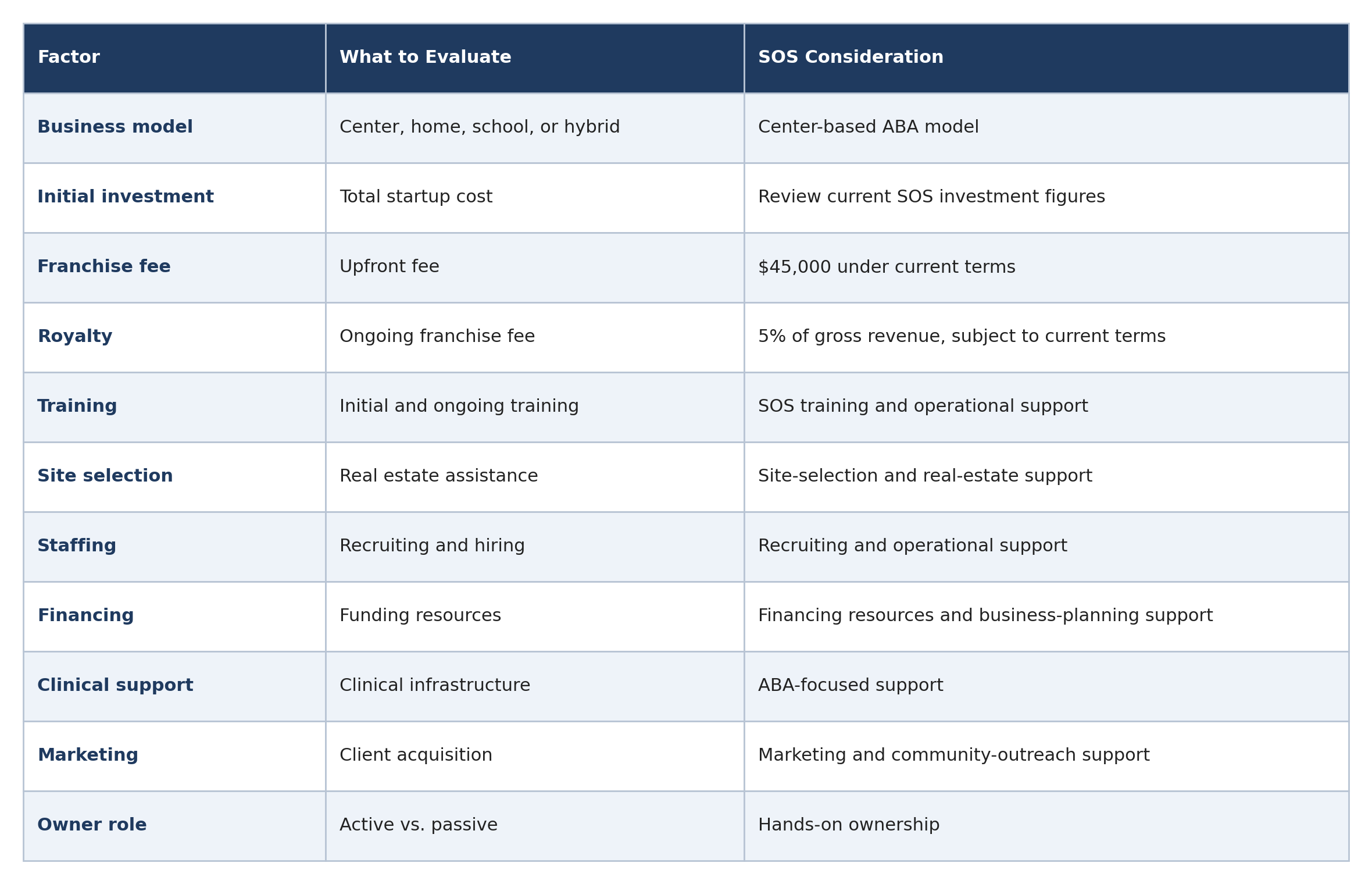
This table is a starting point, not a substitute for due diligence. Investment amounts, fees, support programs, and other franchise terms can change. Always verify current information against the latest SOS materials and FDD before making an investment decision.
How to Compare ABA Franchises Before You Invest
Once you understand the differences, create a structured process for comparing your options.
Step 1: Define Your Ownership Goals
Start with yourself.
Do you want to:
- Operate one location?
- Build multiple locations?
- Be involved every day?
- Build a mission-driven business?
- Eventually expand into additional territories?
Your answers will help determine which franchise model makes sense.
Step 2: Compare Total Investment
Don’t stop at the franchise fee.
Build a complete picture of what it will take to open and operate the business, including working capital and other ongoing expenses.
Step 3: Read Each FDD
The Franchise Disclosure Document is one of the most important resources available to a prospective franchisee.
Pay particular attention to:
- Initial investment
- Franchise fees
- Royalties
- Other fees
- Financial performance representations
- Franchisee turnover
- Litigation
- Franchisee obligations
- Restrictions and renewal terms
Have qualified legal and financial professionals review the document with you.
Step 4: Talk to Current Franchisees
The franchisor can explain the system.
Current franchisees can explain what it is like to live with the system.
Ask them about:
- Opening the business
- Franchisor support
- Staffing
- Owner workload
- Unexpected expenses
- Technology
- Marketing
- Financial performance
- Communication with the franchisor
Their experience can help you identify questions you may not have considered.
Step 5: Compare the Support Systems
Don’t simply count the number of services listed on a franchise website.
Ask what you actually receive.
For example, “marketing support” could mean anything from a collection of templates to a comprehensive lead-generation program.
The same applies to training, recruiting, technology, site selection, and clinical support.
Step 6: Evaluate the Territory
A recognizable brand does not eliminate local market risk.
Study the territory, competitors, demographics, available workforce, payer environment, referral opportunities, and potential demand.
Step 7: Consider the Owner Experience
Finally, ask yourself:
“Can I see myself actually running this business?”
An ABA franchise can combine entrepreneurship with a meaningful mission. But it is still a business that requires leadership, financial planning, staffing, compliance, and day-to-day decision-making.
The opportunity should fit both your financial capacity and your willingness to take on the responsibilities of ownership.
Conclusion: Compare the System, Not Just the Brand
Choosing an ABA franchise is about more than finding a recognizable name.
The better comparison looks at the complete franchise system.
SOS Franchising is one example of a specialized ABA franchise model, with a center-based approach, hands-on ownership expectations, and support across areas such as site selection, training, staffing, marketing, and operations.
But every prospective franchise owner should conduct their own comparison.
Talk with existing franchisees. The right ABA franchise is not necessarily the one with the lowest fee or the biggest headline.
It is the one whose business model, support structure, financial requirements, clinical infrastructure, and ownership expectations align with what you want to build.
FAQs
- Are all ABA franchises the same?
No. ABA franchises can differ in service model, investment, royalty structure, owner responsibilities, clinical support, staffing, technology, territories, training, and marketing.
- Is a lower franchise fee always better?
No. The franchise fee is only one part of the investment. Compare the total startup cost, working capital requirements, ongoing royalties, marketing fees, technology costs, and other expenses.
- Should I talk to existing ABA franchise owners?
Yes. Current and former franchisees can provide valuable insight into the actual owner experience, including startup, support, staffing, costs, and day-to-day responsibilities.
- Where can I find financial information about an ABA franchise?
Start with the franchise’s FDD, particularly its investment, fees, and financial performance sections. Review the information with qualified legal and financial advisors before making a decision.
- What makes SOS different from other ABA franchises?
SOS focuses specifically on operating center-based autism treatment businesses and provides franchise support. Prospective owners should compare these offerings with those of other ABA franchises to determine which system best fits their goals.
The SOS Franchise Editorial Team shares insights and guidance for aspiring and current ABA clinic owners on franchising, operations, and growth with SOS Franchising.