

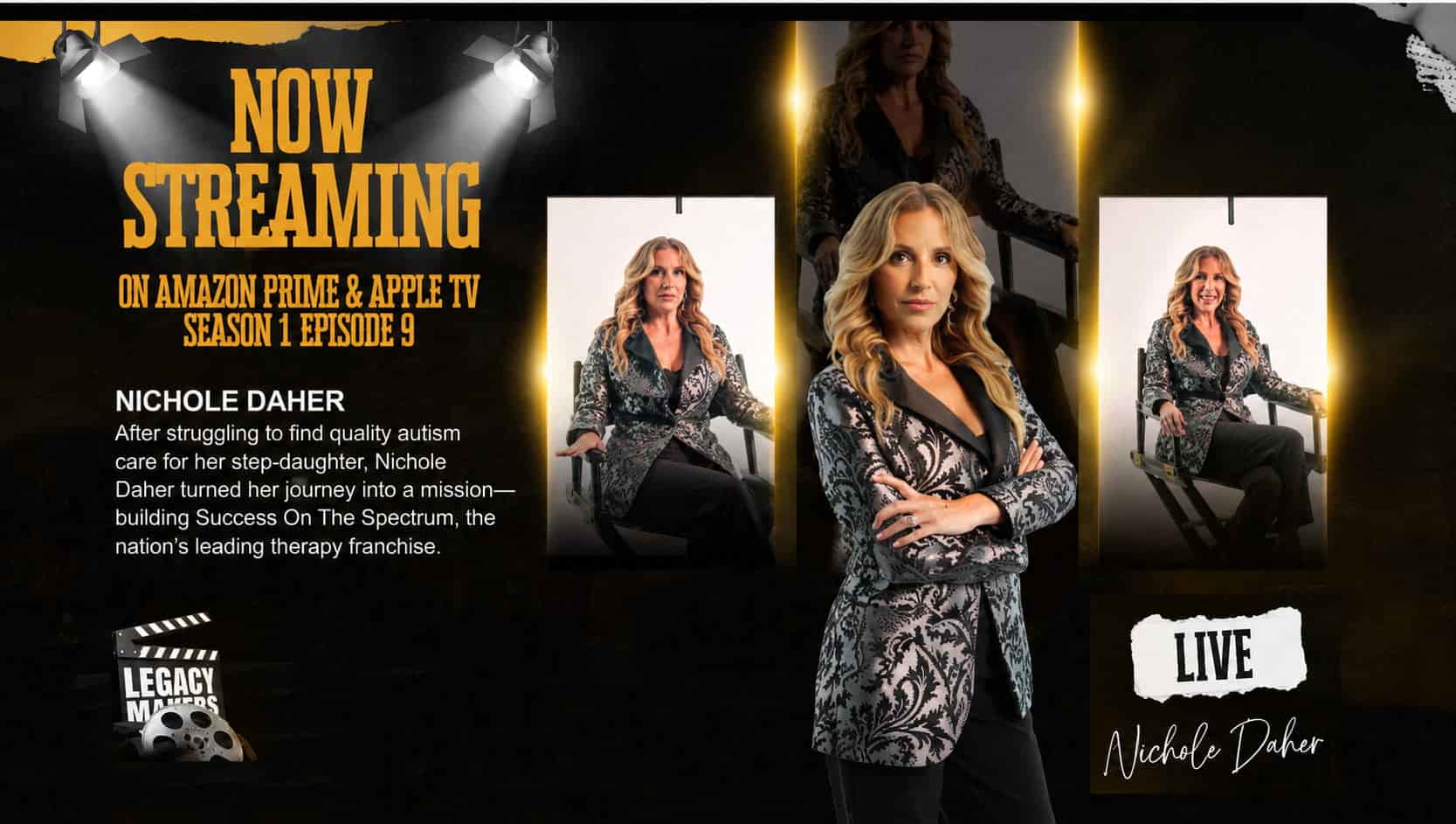
Summary: Nichole Daher, founder of Success On The Spectrum, is featured in Season 1, Episode 9 of Legacy Makers. The episode is now streaming on Apple TV and Amazon Prime. It follows Daher’s personal search for better autism care, a journey that ultimately led to the creation of Success On The Spectrum, the first autism treatment franchise in the United States.
The new docu-series, Legacy Makers, features Nichole Daher, Founder of Success On The Spectrum. The episode shows how a parent’s frustration with the autism care system evolved into a structured business model built around quality, family visibility, and local leadership. Daher’s story also demonstrates how non-clinical franchise owners can operate ABA therapy centers while licensed professionals oversee and deliver clinical care.
Success On The Spectrum began with Daher’s experience as a parent trying to find care that felt complete, visible, and supportive. She was not a clinician. She was a mother looking for better answers.
In 2015, Daher founded Success On The Spectrum as an autism treatment center. In 2018, she founded SOS Franchising, creating the first autism treatment franchise in the U.S.
Franchising became the growth model because ABA clinics require strong systems. Owners need support around site planning, hiring, onboarding, insurance workflows, marketing, staff training, software, and quality standards. Without that structure, even mission-driven clinics can struggle to operate consistently.
SOS was designed for hands-on owners who want to lead a real healthcare business. It is not a passive franchise, not an absentee model, and not a clinical certification path. It is a structured operating model for entrepreneurs who want to serve families while following a proven system.
Legacy Makers highlights the operating principles that make SOS different from many clinic formats.
SOS centers include closed-circuit video surveillance systems so caregivers can see therapy in real time. The model also includes play-based ABA therapy, specialized treatment rooms, in-center BCBA supervision, community events, and recurring quality audits.
These elements are not surface-level features. They help create a clinic environment where families can feel informed, clinicians can work within clear standards, and owners can manage the business with better structure.
The model also protects clinical boundaries. Owners manage the administrative part of business. BCBAs lead care planning. RBTs implement therapy programs under supervision. That separation is one reason SOS can welcome entrepreneurs from corporate, education, healthcare-adjacent, veteran, and parent backgrounds.
The autism services field has seen growth from large corporate and investment-backed providers. Scale can bring resources, but it can also raise questions about local accountability and family experience.
SOS takes a different path by pairing national support with owner-operator leadership. Each franchise owner is expected to stay involved in the business, understand the local community, support team culture, and maintain brand standards.
That matters because families are not only choosing a clinic. They are trusting a team with their child’s development. When the owner is present and accountable, the clinic can feel more personal while still benefiting from national systems.
One of the strongest themes in Daher’s story is family visibility. In many therapy environments, caregivers may not always know what happens during sessions. SOS designed its centers to make the therapy experience easier to understand.
Closed-circuit video surveillance systems allow caregivers to observe sessions without interrupting therapy. This can reduce uncertainty, strengthen communication, and help families see how skills are being taught.
The benefit extends beyond observation. When caregivers understand therapy strategies, they can better support skill-building at home. They can also have more informed conversations with the clinical team about goals and progress.
For SOS, visibility is part of how the brand builds trust and accountability.
A major message in Legacy Makers is that SOS franchise owners do not need to be clinicians. They need leadership ability, financial readiness, people management skills, and willingness to follow a healthcare-grade operating system.
The owner’s role includes hiring, payroll, local marketing, community outreach, team support, and overall center management. The clinical team handles assessments, supervision, treatment planning, and therapy delivery.
SOS supports owners through training, credentialing guidance, onboarding systems, marketing resources, operating manuals, templates, staff education tools, and ongoing support. The brand also provides guidance around insurance workflows and revenue cycle education, while making clear that payer approvals, rates, and timelines vary.
Running an ABA center requires organized systems. SOS uses Maestro, its proprietary software platform, to support scheduling, onboarding, payroll coordination, compliance tracking, billing workflows, and clinic operations.
The system connects with QuickBooks and Learning Zen to support administrative and training processes. Franchisees also receive templates for HR, billing, and caregiver communication.
This technology helps reduce the burden of building operational processes alone. It also helps owners keep key parts of the business connected, from staff training to payroll coordination and documentation.
Technology does not replace leadership. It gives owners a more consistent foundation for managing the business side of the clinic.
SOS locations also host quarterly social events for neuro divergent children and their caregivers. These events create space for socialization, confidence-building, inclusion, and public awareness.
For owners, these events are a way to become part of the local fabric. A clinic can be more than a service location. It can become a place where families feel seen, welcomed, and supported.
This matters for franchise candidates because SOS is built for people who want to lead locally, not own from a distance.
Legacy Makers arrives at a time when more entrepreneurs are looking for businesses with purpose, structure, and long-term relevance. ABA therapy sits at the intersection of healthcare, family support, and local leadership.
| Industry Trend | Impact |
|---|---|
| Rising autism diagnoses | More families are seeking early intervention services |
| Family visibility | Builds trust and strengthens communication |
| Franchise systems | Supports structured, ethical expansion |
| Local leadership | Keeps owners close to the families they serve |
The documentary matters because it shows the human story behind the franchise system. It presents SOS as a model built from personal experience, operating discipline, and a clear mission.
Daher’s episode speaks directly to people who want ownership with purpose. Her journey shows that building a healthcare company takes perseverance, innovation, strong standards, and respect for the families being served.
For women entrepreneurs, parents, career switchers, and healthcare-adjacent leaders, the message is. You do not need to be a clinician to lead in this space. You need the right system, the right team, and the commitment to operate.
Nichole Daher’s Legacy Makers feature highlights why Success On The Spectrum has become an important name in ABA franchising. The episode tells the story of a founder who turned personal experience into a national model.
SOS’s franchise system gives non-clinical owners a way to lead ABA therapy centers while licensed professionals manage care. With family visibility, local leadership, clinical separation, technology, training, and quality standards, the model shows how franchising can support responsible growth in autism services.
For prospective owners, the takeaway is simple: SOS is built for people who want to run a meaningful business, stay involved, and follow a system that puts children, families, and quality at the center.
1. Where can I watch Nichole Daher’s Legacy Makers episode?
Nichole Daher appears in Legacy Makers Season 1, Episode 9. The episode is available on Apple TV, and SOS has announced it as streaming on Amazon Prime and Apple TV.
2. Is autism therapy a good business opportunity?
ABA therapy can be a meaningful healthcare business category because many families need ongoing services for children with autism. Business results vary by market, staffing, payer mix, operations, and execution.
3. Do SOS franchise owners need clinical experience?
No. SOS franchise owners do not need clinical experience. Owners manage business operations while licensed professionals oversee therapy services and clinical decisions.
4. What support does SOS provide franchise owners?
SOS provides operational training, credentialing guidance, marketing resources, onboarding systems, Maestro software, templates, staff training tools, and ongoing support.
5. Why is family visibility important in ABA therapy?
Family visibility helps caregivers understand what happens during therapy, improves communication with the clinical team, and supports skill-building outside the clinic. At SOS, viewing windows or closed-circuit systems allow caregivers to observe sessions in real time.

Nichole Daher is an American entrepreneur, book author, autism advocate, and founder of Success On The Spectrum (SOS)-the first autism treatment franchise in the United States-known for its parent viewing rooms and quality-driven ABA services. She currently serves as CEO of SOS Franchising, where she provides support, resources, and opportunities for entrepreneurs to open their own Success On The Spectrum autism centers.