


Summary: Many professionals feel burned out because their work does not lead to real ownership. The healthcare field needs structured operators as autism therapy services continue to expand. Franchising provides a clear path to business ownership, where your work leads to measurable outcomes but still requires active involvement and consistent performance.
Corporate burnout does not always arise from excessive work hours.
Most cases of burnout occur when employees work hard but lack proper control over their work.
You arrive at work. You fix issues. You achieve your objectives.
The results of the work still belong to a different person who worked on the project.
Because of this, many professionals are rethinking their career paths and exploring business ownership as a practical next step. Some are now looking at healthcare franchise ownership, where structured systems allow them to apply their skills while building leadership in a growing healthcare business.
Burnout has become a common part of working life. Gallup found that 76% of employees experience burnout at least sometimes.
That number matters because burnout is rarely just about being busy. It often reflects a deeper problem. Many professionals feel that their effort, decisions, and long-term growth are tied to systems they do not control.
Over time, that creates a shift in mindset. People start asking harder questions.
That is where business ownership starts to become more than a vague idea. It becomes a serious next step.
Many people assume corporate professionals want out because they are looking for an easier life.
That is usually not true.
Most are not trying to avoid responsibility. They are trying to move closer to it. They want clearer ownership of outcomes. They want their work to connect more directly to what they build, how they lead, and what kind of future they create.
That is a big reason franchising has become more relevant for experienced professionals.
It offers structure, but it also creates room for ownership.
In a corporate role, you are often executing inside a system that already exists. As an owner, you are operating the system. You are still leading people, solving problems, and managing performance. The difference is that the work now connects directly to the business you are helping grow.
A lot of professionals are more prepared for ownership than they realize.
They already know how to:
These are the same types of skills that matter in a structured business environment.
That is one reason franchise ownership often feels more accessible than starting a business from zero. It allows people to use the experience they already have while stepping into a role with more direct accountability.
The appeal is not just independence. It is the chance to apply proven leadership skills in a setting where the outcomes are more closely tied to your decisions.
Not every industry creates the same type of opportunity for first-time owners.
Some sectors rise and fall with trends. Others depend heavily on consumer spending cycles. Healthcare works differently. It is driven by ongoing need. That makes it especially relevant for professionals who want to build something more stable and more useful over time.
The need for autism services is one clear example.
The CDC reports that 1 in 36 children in the United States has been identified with autism.
That statistic does not just point to awareness. It also reflects a growing need for structured support services, including Applied Behavior Analysis, or ABA, therapy. For professionals exploring healthcare ownership, this creates an important intersection. There is demand in the market, but the work also requires structure, consistency, and accountability.
Demand alone does not make a business model strong. Healthcare is a serious operating environment. It requires the right systems, the right staffing, the right workflows, and the right standards. That is especially true in autism therapy.
Running a center-based ABA clinic involves:
That complexity is one reason many professionals look for a structured ownership model instead of trying to build everything on their own. They are not looking for shortcuts. They are looking for a system that makes the complexity more manageable.
Starting any business from scratch means building the foundation yourself.
That includes:
In healthcare, those decisions carry more weight because execution affects both business performance and service quality. Franchising gives professionals a way to enter ownership through a more defined structure.
Instead of improvising every part of the model, they can operate within an established framework that includes guidance, training, and brand standards. That structure can make the transition from employee to owner more practical, especially for people who are comfortable leading inside systems but do not want to invent every process from zero.
Sometimes the difference is easiest to see side by side.
| Factor | Independent Startup | Structured Franchise System |
|---|---|---|
| Operating systems | Built from scratch | Provided through an established model |
| Training | Self-directed | Guided training and onboarding |
| Brand presence | Built over time | Existing brand recognition |
| Setup process | Trial and error | More clearly defined path |
| Operational guidance | Self-created | Ongoing support and standards |
This does not remove the work. It makes the path clearer.
For many professionals, that clarity matters. It reduces guesswork during a major career transition and creates more confidence in how the business is meant to run.
ABA therapy centers are not general service businesses.
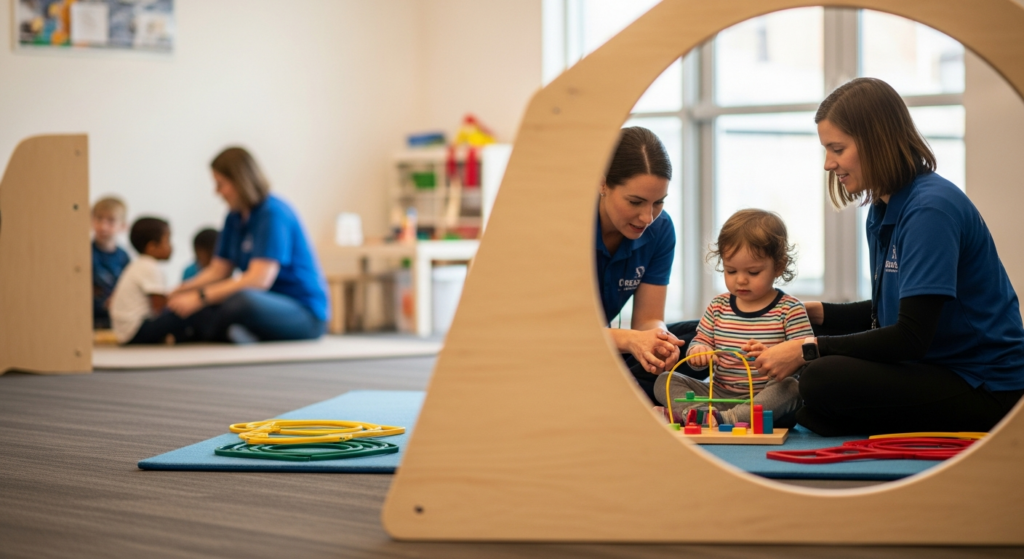
They operate inside a healthcare setting where consistency matters every day. The goal is to support children through structured therapy programs that build communication, learning, and daily living skills. That means the business model depends on more than customer acquisition. It depends on how well the center runs.
A typical ABA center includes:
This is why many professionals are drawn to the model. It is mission-driven, but it also rewards process discipline. The work has purpose, but it still requires strong management.
| Area | What It Covers |
|---|---|
| Clinical delivery | Therapy sessions led by trained staff |
| Staffing | Hiring, onboarding, and team support |
| Scheduling | Managing availability, therapy hours, and center capacity |
| Billing workflows | Documentation and insurance-related processes |
| Family communication | Ongoing coordination and transparency |
| Operations | Daily systems, consistency, and clinic performance |
For professionals coming from corporate environments, this structure often feels familiar in a useful way. It is organized, process-based, and outcomes-driven. The difference is that the work now supports both business ownership and community impact.
One of the biggest reasons professionals begin looking at healthcare franchises is that they want their next chapter to feel more meaningful.
They do not just want more control. They want more connection to the work itself.
Healthcare offers that.
Autism therapy, in particular, sits at the intersection of operational leadership and visible community value. Owners are not delivering therapy themselves, but they are responsible for helping create an environment where high-quality services can be delivered consistently.
That matters to people who want to build something real.
For many, this is the shift:
Purpose alone is not enough to run a healthcare operation well. That is one of the most important points in this conversation.
Many professionals are motivated by the mission. They care about families. They care about impact. They want the work to mean something.
But healthcare still runs on systems.
That is why a structured franchise model matters. It helps turn motivation into repeatable operations. It gives owners a framework for decision-making, staffing, setup, and daily management.
In a model like Success On The Spectrum, the role of the owner is not to guess their way through clinic operations. It is to lead within a system that is designed to support consistency, quality, and accountability.
That is often what makes the transition feel more realistic.
Ownership changes the relationship people have with work. You gain more control. You also carry more responsibility. That is what makes this path appealing to the right kind of professional.
People who do well in structured healthcare ownership often want:
They are not looking to disappear from the business. They want to build and lead it.
That makes the shift from corporate life feel less like a break and more like a realignment.
The timing makes sense.
Burnout is pushing people to reassess how they work. Healthcare continues to reflect real and lasting demand. Franchising offers a more structured entry point into ownership. And models like ABA therapy combine purpose with operational depth.
That combination is hard to ignore.
Professionals are not moving toward healthcare franchises because they expect a simple path. They are moving because they want a clearer one.
The presence of corporate burnout often signals a need for deeper change. Many professionals are not looking to step away from work, but to grow through more active roles. They want to take on positions that offer real responsibility within a structured system, where their efforts create lasting value.
Healthcare franchising has become part of this conversation because it operates within an essential industry. It provides a clearer path for professionals to move into business ownership while working within defined systems. In areas like autism therapy, these models help address growing service needs through structured operations.
For those exploring structured healthcare ownership, SOS Franchising supports entrepreneurs in building and operating high-quality ABA therapy centers through systems, training, and ongoing guidance.
No. In structured ABA franchise models, owners focus on operations, leadership, and clinic management, while clinical services are delivered by qualified professionals.
They offer a more structured path into ownership, especially for professionals who already have experience in management, systems, and team leadership.
The CDC reports that 1 in 36 children in the U.S. has been identified with autism, which continues to increase the need for structured therapy services.
Franchising provides an established framework with training, systems, and guidance, which can reduce guesswork during setup and operations.
This path tends to fit hands-on professionals who value structure, accountability, and mission-driven business ownership.

Nichole Daher is an American entrepreneur, book author, autism advocate, and founder of Success On The Spectrum (SOS)-the first autism treatment franchise in the United States-known for its parent viewing rooms and quality-driven ABA services. She currently serves as CEO of SOS Franchising, where she provides support, resources, and opportunities for entrepreneurs to open their own Success On The Spectrum autism centers.