

Summary: Food franchises depend on their daily customer traffic together with their ongoing operational activities. The need for established operational systems in healthcare franchises, along with their requirement for continuous service provision, enables them to achieve predictable results throughout their operational timeline. The right choice depends on your business preference between fast-paced models and system-driven business operations.
Most people compare franchises based on cost, brand name, or how fast they can open. That approach misses what actually determines whether a business works long term.
A food franchise and a healthcare franchise may look similar on paper, but they operate on completely different systems. One depends on daily customer traffic. The other depends on structured service delivery, compliance, and consistency.
If you are deciding between the two, the better investment is not obvious. It depends on how the model actually runs, not how it is marketed.
The process of becoming a business owner through franchising appears simple. The operational procedures of your business will depend on the franchise system you select.
First-time franchise owners commonly choose food franchises because these businesses offer high visibility and simple operational models. Healthcare franchises operate quietly in the background yet continue to expand their market presence. The CDC reports that 1 in 36 children in the U.S. has been identified with autism, increasing the need for therapy services.
Restaurant businesses must deal with ongoing challenges from rising expenses and their competitive environment. The U.S. Bureau of Labor Statistics reports that most businesses in this industry fail within their initial five years.
The comparison holds significance because the two models exhibit different structural characteristics and risk profiles and their ability to sustain operations over time.
A food franchise is built around a simple idea: consistent products delivered at scale.
The franchisor provides:
The franchisee runs the location and manages everything locally.
Revenue depends on:
The model is volume-based. If customers stop coming, revenue drops immediately.
Food franchise owners typically manage:
This creates a fast-moving environment where consistency and efficiency matter every day.
Healthcare franchises follow a different structure. They are not driven by walk-in customers. Instead, they provide regulated services based on defined systems and professional oversight.
Applied Behavior Analysis (ABA) therapy focuses on:
Services are:
Revenue is tied to approved therapy hours, not customer traffic.
Understanding the difference becomes clearer when you look at them side by side.
| Factor | Food Franchise | Healthcare Franchise |
|---|---|---|
| Revenue Model | Customer transactions | Authorized service hours |
| Demand Driver | Consumer choice | Medical or clinical need |
| Daily Operations | Fast-paced, volume-driven | Structured and scheduled |
| Staffing | Hourly workers | Trained professionals |
| Regulation | Moderate | High |
| Stability | Traffic-dependent | System-driven |
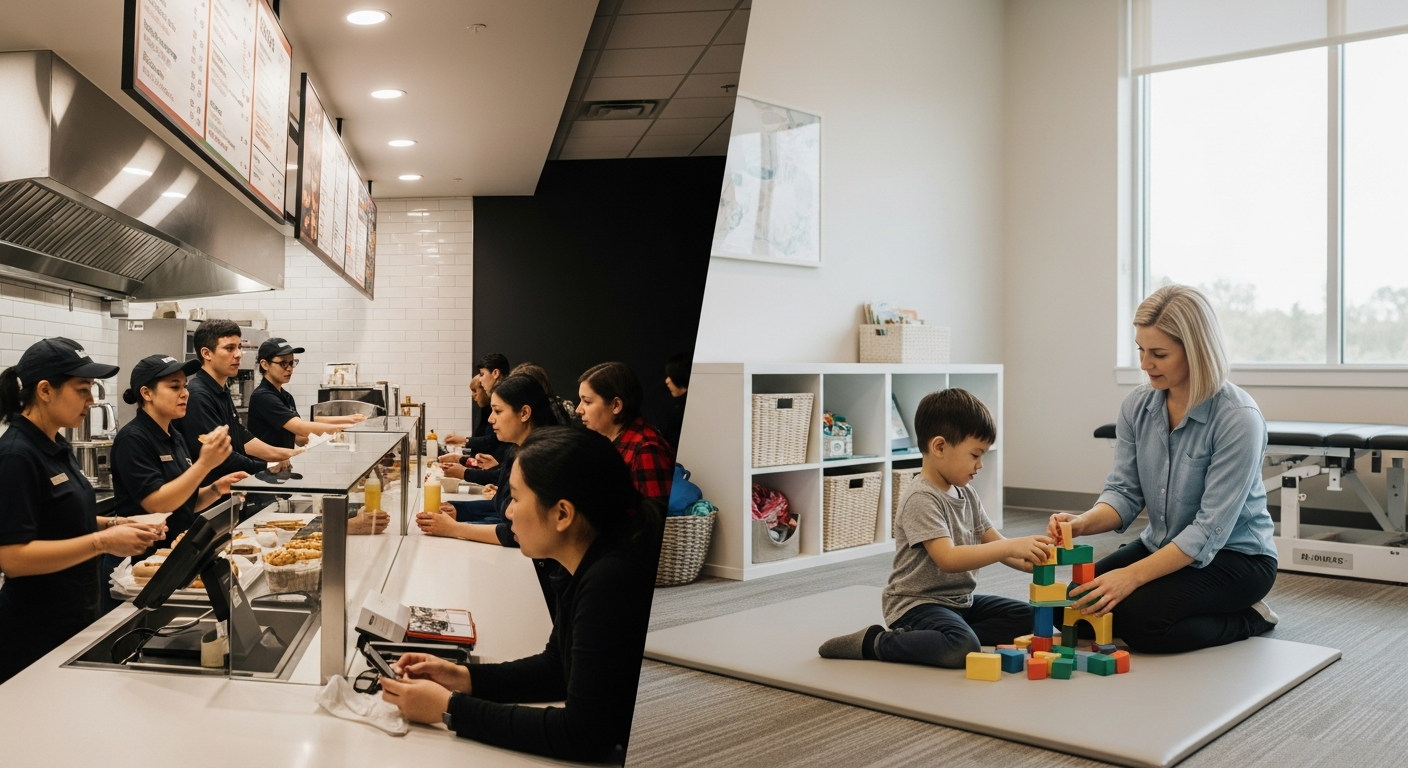
In simple terms, food franchises depend on how many people walk in each day, while healthcare franchises depend on how consistently services are delivered over time.
Before choosing a model, it is important to understand how each one behaves financially.
Food franchises often require:
They can generate revenue quickly, but they are also sensitive to:
Many first-time operators underestimate how much capital is needed to sustain operations in the early phase.
Healthcare franchises typically involve:
The ramp-up can take longer because systems need to be established before revenue stabilizes.
However, once operations are consistent, the model becomes less dependent on daily fluctuations and more dependent on structured service delivery.
The biggest difference between these two models is how money is generated.
Revenue depends on:
This means:
Revenue depends on:
This creates a different type of system:
| Revenue Factor | Food Franchise | Healthcare Franchise |
|---|---|---|
| Revenue Trigger | Customer purchase | Approved service hours |
| Predictability | Low to moderate | Moderate over time |
| Key Risk | Low traffic days | Operational inefficiencies |
| Growth Driver | More customers | Better capacity utilization |
This is why healthcare franchises are often described as system-driven, while food franchises are volume-driven.
Ownership in both models is active, but the nature of the work is different.
Owners typically handle:
The pace is constant, and issues must be solved quickly.
Owners focus on:
The environment is more structured, but it requires attention to detail and consistency.
This is where the two models diverge significantly.
These are important, but they are operational in nature.
Healthcare operations carry a higher level of responsibility because services directly affect people’s well-being.
However, it can also fluctuate based on:
The growth is tied to:
Choosing between these two models depends on how you want to operate.
Success On The Spectrum (SOS) operates within the healthcare franchise category, specifically in ABA therapy. The model is designed for hands-on owner-operators, not passive investors. SOS provides:
At the same time:
This creates a system where ownership is supported, but still requires active involvement.
The two franchise models function as viable options yet demand completely different approaches from their operators. A food franchise rewards speed, efficiency, and the ability to handle constant change. A healthcare franchise requires operators to establish organized systems which need ongoing maintenance for their operational processes.
The first option operates based on what customers need at that moment. The second option functions through its established operational procedures which continue to provide services. The business operation develops into two distinct aspects which build up to determine the business’s operational status and your ability to steer its results.
Before choosing, it is worth asking a simple question: do you want to manage daily volume or do you want to manage a system that runs over time?
See how SOS structures its franchise system: https://sosfranchising.com/
A food franchise depends on daily customer transactions, while a healthcare franchise operates on structured service delivery based on approved care.
Healthcare franchises can become more predictable over time because they rely on ongoing service demand, but they require stronger systems and compliance.
No. In models like ABA therapy, licensed professionals deliver care, while the owner manages operations.
Both have risks. Food franchises face daily revenue variability, while healthcare franchises involve regulatory and operational complexity.

Nichole Daher is an American entrepreneur, book author, autism advocate, and founder of Success On The Spectrum (SOS)-the first autism treatment franchise in the United States-known for its parent viewing rooms and quality-driven ABA services. She currently serves as CEO of SOS Franchising, where she provides support, resources, and opportunities for entrepreneurs to open their own Success On The Spectrum autism centers.