


Summary: Franchise ownership remains a strong path in 2026, especially in sectors tied to essential services rather than consumer trends. ABA therapy stands out because demand is driven by rising autism diagnoses, long-term need for evidence-based care, and the relative stability of healthcare services across economic cycles. Unlike retail or food franchises, ABA therapy centers address critical developmental needs while building lasting trust with families.
Success On The Spectrum (SOS) offers a structured, healthcare-focused franchise system for hands-on entrepreneurs who want to lead with purpose. With training, operational systems, quality oversight, and market guidance, SOS supports owners in building ethical, high-quality ABA therapy centers, without requiring prior clinical experience.
The 2026 Franchise Question Isn’t “What’s Trendy?”, It’s “What Holds Up?”
Every year, the “best franchise to invest in” lists tend to recycle the same categories: food, fitness, home services, retail. Some of those can work. But heading into 2026, more entrepreneurs are asking a more practical question:
What type of business stays relevant when consumer behavior shifts, costs rise, and competition tightens?
That’s where healthcare-adjacent franchises have gained more attention, especially models tied to essential services rather than discretionary spending. And within that category, ABA therapy (Applied Behavior Analysis) stands out because demand is being driven by real-world need, not trend cycles.
In this guide, we’ll walk through:
Franchising remains one of the most structured ways to step into business ownership, especially for first-time entrepreneurs who want clearer playbooks, training, and brand infrastructure.
According to the International Franchise Association’s 2025 outlook, franchising is projected to:
That matters because franchising isn’t just a “business category.” It’s an operating ecosystem where you’re not building everything from scratch:
If you want ownership with fewer unknowns than a blank-slate startup, franchising is still one of the most practical structures available in 2026.
Rising autism prevalence
The need for autism services has increased alongside rising identification rates.
This isn’t a small shift. It directly impacts:
A growing ABA market
Industry research also points to continued expansion of ABA services. For example, Mordor Intelligence estimates the ABA market at $7.97B in 2025, projecting growth to $9.96B by 2030 (CAGR ~4.56%).
What this means: Demand isn’t hypothetical. It’s data-backed, and it’s tied to service capacity. In many markets, families don’t ask “should we get therapy?”, they ask “how long is the waitlist?”
Let’s be careful with language here: no ethical healthcare business should be described as “recession-proof.”
But historically, healthcare employment and services have shown stability across business cycles. A peer-reviewed analysis (pre-COVID era, 2005–2017) found the healthcare sector to be stable and in some areas, healthcare employment increased during more severe downturns.
ABA therapy; when delivered as medically necessary care, generally behaves more like essential healthcare than discretionary consumer spending.
What this means: For many owners, ABA therapy can feel more predictable than franchises that rise and fall with consumer confidence.
Built-in demand + specialized services
ABA therapy serves a clear need: helping children build communication, learning, and daily living skills while reducing behaviors that interfere with development.
Many centers also coordinate or integrate complementary services such as:
This isn’t about “upsells.” It’s about offering families a more complete, coordinated care experience.
Structured growth with community impact
ABA isn’t just a business model. It’s a service model with real consequences:
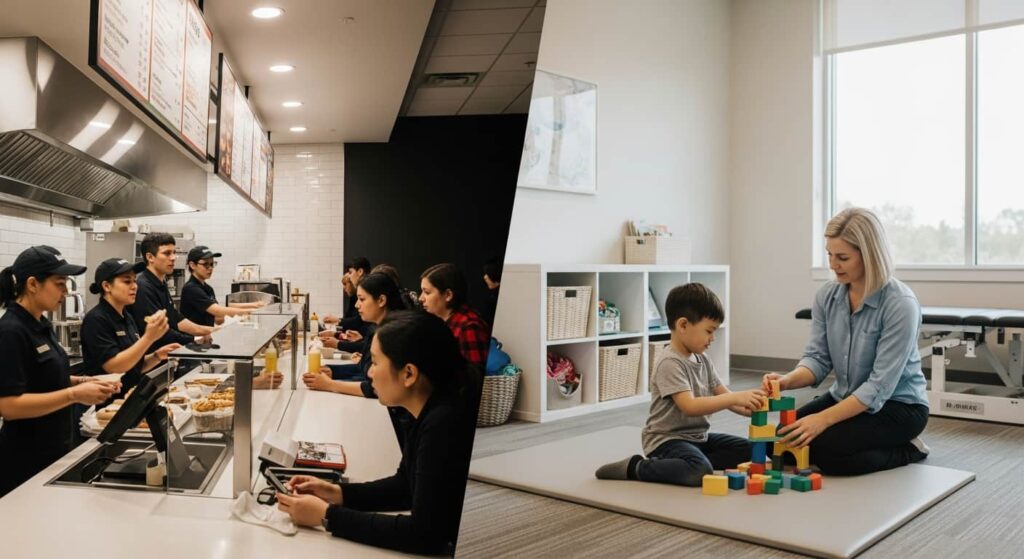
What this means: Compared to general retail or food franchises, ABA therapy can offer a rare combination: long-term demand + mission + operational depth.
At SOS, we’re built for entrepreneurs who want to be hands-on owner-operators in a healthcare-grade business, without needing prior clinical experience.
Our Positioning
SOS exists to support ethical, scalable expansion of autism services through:
We operate at the intersection of:
SOS franchisees receive a structured franchise system that includes:
What this means: SOS is not a passive franchise and not an “investment-first” concept. It’s a healthcare operating model designed for owners who want to lead.
1) Lower Operational Guesswork with Proven Systems
Franchise models reduce trial-and-error by giving you a tested operating structure:
In healthcare, “figuring it out as you go” is expensive and risky.
2) Long-Term Demand with Measurable Impact
As diagnoses and awareness rise, families seek consistent, high-quality providers. This can translate into long-term demand for centers that deliver reliable care.
3) Community Trust and Retention
ABA centers build trust through:
That trust becomes reputation, and reputation becomes stability.
What this means: You’re building a business that can grow while delivering essential services in your community.
| Franchise Sector | What demand depends on | Typical risk profile | What usually drives growth |
|---|---|---|---|
| Food & Retail | Consumer spending + location saturation | High competition, thin differentiation | Price, convenience, trend fit |
| Fitness & Wellness | Consumer behavior + churn | Seasonality + retention pressure | Marketing + experience |
| Home Services | Local demand + staffing availability | Operational complexity | Reviews, speed, dispatch quality |
| Healthcare (ABA therapy) | Essential care demand + service capacity | Higher compliance needs, higher standards | Quality, outcomes, payer mix, staffing stability |
What this means: Many franchise categories can work. But ABA therapy is less trend-driven and more need-driven, if you’re prepared for healthcare-grade operations.
1) Match Mission with Model
Ask yourself:
SOS is designed for hands-on owners. If you want passive ownership, we’re not the right fit and we’re clear about that.
2) Evaluate Support Infrastructure (Especially in Healthcare)
In ABA, “support” can’t be vague. Look for specifics:
3) Validate Market Demand Locally
Even with strong national demand signals, local reality matters:
What this means: The best franchise choice is data + fit. Not hype.
In 2026, the strongest franchise bets aren’t just the ones with the loudest marketing. They’re the ones tied to:
ABA therapy sits at that intersection.
If you’re exploring franchise ownership and want a model built around ethical expansion, hands-on ownership, and healthcare-grade operations, we invite you to learn more about SOS Franchising.
Ready to explore an ABA therapy franchise with purpose and support? Call us now!
What makes ABA therapy franchises a strong investment in 2026?
ABA therapy demand is supported by rising autism identification rates. At the same time, essential healthcare services have historically shown stability across business cycles. That combination can make ABA a compelling category for entrepreneurs seeking purpose plus long-term demand.
Do I need clinical experience to own an ABA therapy franchise?
No. At SOS, franchise owners are business operators. Clinical services are delivered by licensed professionals. We provide training, systems, and operational guidance so owners can run the business side responsibly.
How do ABA therapy franchises like SOS support new owners?
We support owners through:
We provide guidance and structure, while owners lead execution locally.
Is the ABA therapy market growing nationwide?
National data shows increasing autism identification, which supports rising demand for therapy services.
Market research firms also project continued growth in ABA services in the coming years.
How is SOS different from other ABA or healthcare franchises?
SOS is built around an owner-operated model with:
We’re designed for entrepreneurs who want to lead and want a system that supports ethical, consistent care.

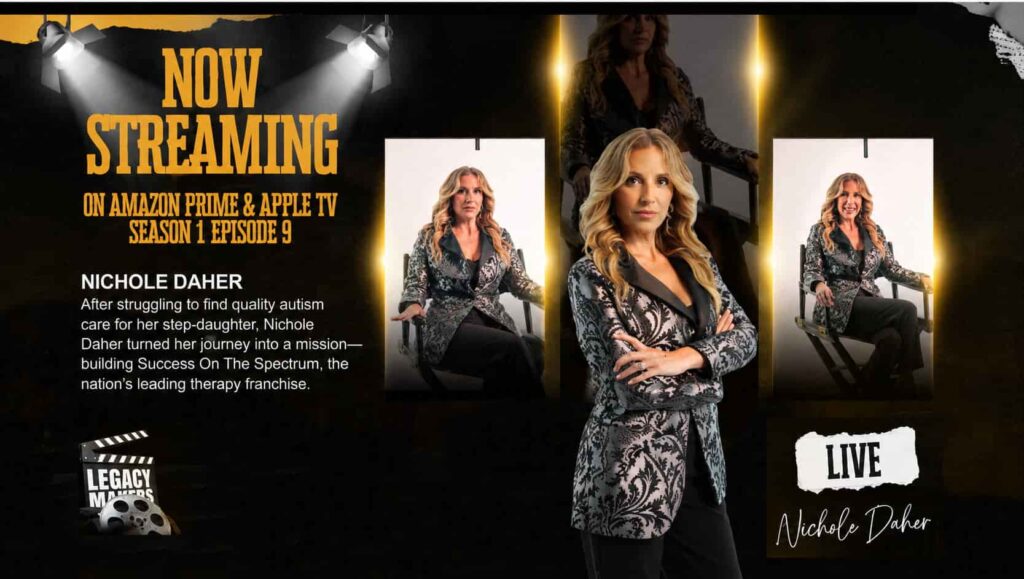
Nichole Daher is an American entrepreneur, book author, autism advocate, and founder of Success On The Spectrum (SOS)-the first autism treatment franchise in the United States-known for its parent viewing rooms and quality-driven ABA services. She currently serves as CEO of SOS Franchising, where she provides support, resources, and opportunities for entrepreneurs to open their own Success On The Spectrum autism centers.